

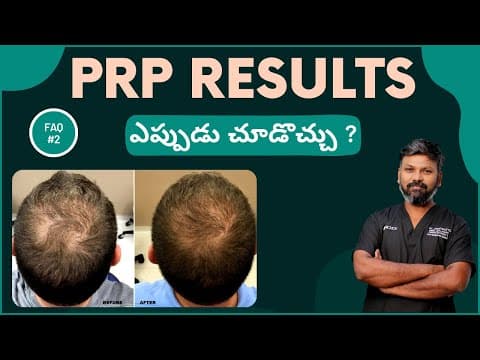
Platelet-Rich Plasma (PRP) therapy generates a lot of questions — and a lot of confusion. How many sessions are enough? Does it work the same for men and women? And when can you realistically expect to see new hair?
In this article based on his educational video, Dr. John Watts — dermatologist, trichologist and hair transplant surgeon in Hyderabad who has performed over 2,000 hair transplant surgeries — answers shortlisted viewer questions about PRP and busts some common myths along the way.
How many PRP sessions are needed?
According to Dr. Watts, you ideally need at least 6 to 8 sessions of PRP to get results. Equally important is having the right expectations: PRP is useful for people facing normal hair fall, normal hair thinning and low hair growth — not for reversing baldness.
“We usually wait and monitor for 2-4 months to see the growth after 6-8 sessions of PRP. If there are no significant results, we recommend a booster PRP session after 4-6 months. During this time, one may need to continue the hair medication,” informed Dr. John Watts.
So PRP is not a one-and-done treatment. It is a course of sessions, followed by a monitoring period, sometimes with a booster — and usually alongside prescribed hair medication.
Does PRP work for both men and women?
Yes. Dr. Watts explains that PRP is useful for both males and females dealing with normal hair loss, hair thinning and low hair growth problems.
“In such conditions, the results are equal for both males and females if PRP sessions are undertaken,” he said.
However, he is clear about the limitation: PRP sessions are no answer for baldness. If you have progressed to visible bald areas, PRP will not be effective in that situation.
When do PRP results become visible?
Patience matters here. Dr. Watts says results may start appearing from the third PRP session onwards.
“Usually, there is a 20-day gap between the first and second session. It means one has to wait at least one-and-a-half month to two months to notice visible results in the form of baby hair growth,” said Dr. Watts.
The first visible sign of response is typically fine baby hair growth — not instantly thick, dense hair. Fuller results build gradually over the full course of sessions.
The bottom line
PRP can genuinely help with normal hair fall, thinning and slow hair growth — but it needs 6-8 sessions, realistic expectations and a waiting period of roughly one-and-a-half to two months before baby hair appears. It works equally for men and women, but it is not a treatment for established baldness. If you are unsure whether your hair loss is the kind PRP can help, get a proper diagnosis first.
This article is for educational purposes only and is not a substitute for professional medical advice. Consult a qualified dermatologist for diagnosis and treatment.
Instant Appointment Slot Booking
Frequently asked questions
How many PRP sessions are needed for hair growth?
Dr. John Watts recommends at least 6-8 PRP sessions, followed by 2-4 months of monitoring. If results are not significant, a booster session may be advised after 4-6 months, often while continuing hair medication.
Does PRP work for both men and women?
Yes. PRP works equally well for males and females dealing with normal hair loss, hair thinning and low hair growth. However, it is not effective for established baldness.
When do PRP results become visible?
Results may appear from the third session onwards. With a typical 20-day gap between sessions, expect to wait about one-and-a-half to two months to notice visible baby hair growth.
Can PRP cure baldness?
No. Dr. Watts is clear that PRP is not an answer for baldness. It is meant for normal hair fall, thinning and low hair growth problems.