

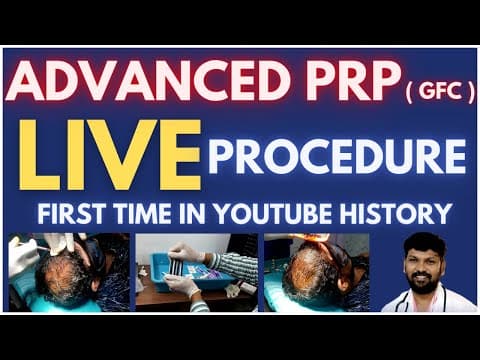
Will a Growth Factor Concentrate (GFC) procedure do any good for your hair growth? Is it better than PRP? Can it solve baldness or replace a hair transplant?
In this article based on his live demonstration video, Dr. John Watts — dermatologist, trichologist and hair transplant surgeon in Hyderabad, with over 1,900 successful hair transplants — explains the GFC procedure step by step and answers all these questions.
Preparing the GFC: from blood to growth factors
The procedure starts with a GFC kit, which comes packed with four sterile tubes containing added growth activators.
Step 1 — Blood collection: 14-16 ml of blood is collected from the patient in the sterilised environment of the hospital or clinic. A tourniquet is tied on the patient's arm, blood is drawn with a needle and transferred into the four sterilised tubes.
Step 2 — Resting: The blood is kept still for 30 minutes and inverted 6-10 times during this period.
Step 3 — Centrifugation: The four tubes are placed in a centrifuge and spun for 10 minutes at 3,400 RPM.
Step 4 — Extraction: The tube is inverted and only the yellowish liquid — the growth factor concentrate — is collected using an insulin syringe.
What happens in the procedure room
In the operation theatre, the scalp is first numbed. "We administer local anaesthesia on the scalp where GFC has to be injected. We usually administer about 40 units of the yellowish GFC liquid via an insulin syringe," explained Dr. John Watts.
During the process, a dermaroller is used until there is pinpoint bleeding, while an attendant keeps the hair combed so it does not tangle. Thanks to the local anaesthesia, the patient feels no pain.
One important safety note: to avoid possible infection from dermaroller use, the process must be done only by trained people in a sterilised atmosphere. "The entire process of administering GFC gets completed in 1-2 hours but one must choose the right hair expert and the right clinic," informed Dr. Watts.
How many sessions, and is it better than PRP?
For good results, Dr. Watts says one must attend at least 5-6 sessions. "GFC always gives better results than a PRP but it is not an alternative to hair transplant," he explained.
Can GFC fix baldness?
No. If one has baldness, GFC cannot do any miracle — it is not even suggested, as it would have no effect at all. "A hair transplant with hair grafts obtained from healthy and non-DHT influenced donor hair is the only option in case of baldness," says Dr. John Watts.
The bottom line
GFC is a refined, growth-factor-rich cousin of PRP that delivers better results across 5-6 sessions — but it works for thinning hair, not bald areas. Choose a trained expert and a sterile clinic setting, and keep expectations realistic: for established baldness, a hair transplant remains the only effective option.
This article is for educational purposes only and is not a substitute for professional medical advice. Consult a qualified dermatologist for diagnosis and treatment.
Instant Appointment Slot Booking
Frequently asked questions
How is GFC prepared?
14-16 ml of blood is collected into four sterile tubes with growth activators, rested for 30 minutes with 6-10 inversions, centrifuged for 10 minutes at 3,400 RPM, and the yellowish growth factor concentrate is extracted with an insulin syringe.
Is GFC better than PRP?
According to Dr. John Watts, GFC always gives better results than PRP, but it is not an alternative to a hair transplant.
How many GFC sessions are needed?
At least 5-6 sessions are needed for good results. Each session takes about 1-2 hours.
Does GFC work for baldness?
No. GFC has no effect on bald areas. A hair transplant using healthy, non-DHT-influenced donor hair is the only option for baldness.