

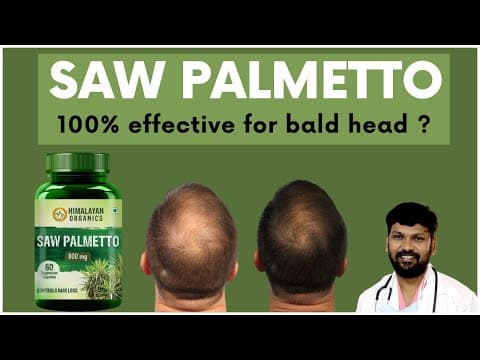
Many people with DHT-induced hair loss hesitate to use Finasteride because it is known to cause side effects in some users. That fear has put Saw Palmetto in the spotlight — a natural product, obtained from the saw palmetto (Serenoa repens) tree, that is believed to be free of side effects. But does it actually promote hair growth? Can it regrow hair on a bald scalp? Is it really a safe alternative to Finasteride?
In this article based on his educational video, Dr. John Watts — dermatologist, trichologist and hair transplant surgeon in Hyderabad with over 1,900 successful hair transplant procedures — separates the marketing from the evidence.
What is Saw Palmetto?
The saw palmetto (Serenoa repens) tree, which grows up to 10 feet tall, is used for medicinal purposes. Its bark is known to have natural DHT-blocking properties that act against androgenetic (hereditary) baldness and help prevent hair loss.
“However, unlike US FDA approved Finasteride, which is a DHT blocking drug to control Androgenetic baldness, there is no approval for Saw Palmetto based drugs in the open market,” said Dr. John Watts.
It is sold in myriad forms: shampoos, tablets of 160 mg and 320 mg, and liquid extracts. Children and pregnant women are advised against its use.
What the head-to-head study found
Researchers conducted an efficacy study comparing the two in patients with androgenetic alopecia, split into two groups. “While one group of patients was given 320 mg of Saw Palmetto based drug, the other group was given 1 mg of Finasteride,” informed Dr. Watts.
The results were stark. The Saw Palmetto group showed no considerable progress, while the results were quite the opposite in the Finasteride group.
“This shows that Finasteride — which is a chemical compound and enjoys FDA approval for use — is a better DHT blocker than Saw Palmetto based drug,” explained Dr. John Watts.
The side effects nobody mentions
The natural-equals-safe assumption did not hold up either. Saw Palmetto users in the study complained of adverse side effects including headache and nausea.
“Though Finasteride also is known to cause side effects to 2% users, Saw Palmetto seems to have other side effects like Hepatitis and Pancreatitis,” explained Dr. Watts.
Given all this, Dr. Watts strictly warns against taking Saw Palmetto products without first consulting a dermatologist. “Self-prescription should be avoided at any cost as it may lead to adverse consequences,” he advised.
The bottom line
Saw Palmetto does have natural DHT-blocking properties, but in a direct comparison study it produced no considerable improvement in androgenetic alopecia, while Finasteride did. It lacks FDA approval, and far from being side-effect-free, it has been linked to headache, nausea, hepatitis and pancreatitis. If side effects worry you, discuss them honestly with a dermatologist rather than self-prescribing a weaker, unregulated alternative.
This article is for educational purposes only and is not a substitute for professional medical advice. Consult a qualified dermatologist for diagnosis and treatment.
Instant Appointment Slot Booking
Frequently asked questions
Is Saw Palmetto as effective as Finasteride for hair loss?
No. In an efficacy study Dr. John Watts cites, patients given 320 mg of Saw Palmetto showed no considerable progress, while those given 1 mg of Finasteride showed clear improvement — making Finasteride the better DHT blocker.
Is Saw Palmetto free of side effects because it is natural?
No. Study participants reported headache and nausea, and Saw Palmetto has been linked to hepatitis and pancreatitis. Finasteride, by comparison, causes side effects in about 2% of users.
Is Saw Palmetto FDA approved for hair loss?
No. Unlike Finasteride, which is US FDA approved for controlling androgenetic baldness, Saw Palmetto based drugs have no such approval in the open market.
Who should avoid Saw Palmetto?
Children and pregnant women are advised against its use, and Dr. Watts warns everyone against self-prescribing it without first consulting a dermatologist.