

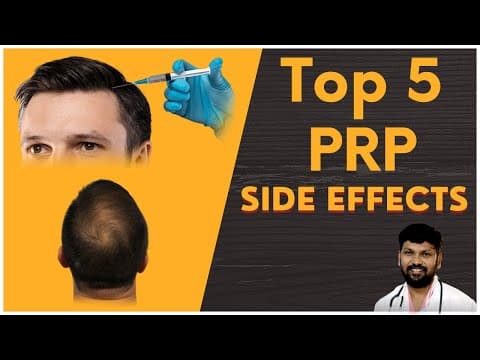
Here's something not commonly known: PRP done in the wrong way, or planned improperly, may lead to hair fall instead of hair growth. The procedure must be performed at a clinic or hospital that follows all precautions to prevent possible infection.
In this article based on his educational video, Dr. John Watts — dermatologist, trichologist and hair transplant surgeon in Hyderabad with over 1,900 successful transplant procedures — explains the adverse effects of PRP carried out without proper protocol.
What PRP can realistically achieve
First, expectations. The purpose of PRP is to ensure hair growth and prevent further hair thinning. You cannot expect full-length, dense growing hair with PRP — but it does help control hair thinning by growing baby hair and ensuring some density. Those goals are only reached if the procedure follows certain conditions.
Pain and discomfort after the session
Anaesthesia is generally administered for PRP, but some pain and occasional mild discomfort after the session is possible. In some cases, patients face severe discomfort because they ignore instructions — for example, taking up driving immediately, exposing the sensitive region of the scalp to injury.
Some hair fall is normal — but watch the amount
You may notice hair fall after the first or second PRP session. This is normal and stabilises in subsequent sessions. In general, losing around 60-100 hairs a day is regarded as normal. However, if there is excess hair fall post-PRP, consult your dermatologist for reassessment.
Scalp fibrosis: the danger of rushed sessions
PRP causes light inflammation of the scalp, which is natural and heals on its own. But trouble starts when sessions are scheduled too close together. If a patient takes PRP sessions in quick succession — with an average gap of just 5-6 days — the scalp gets no time to heal, inflammation aggravates, and a condition called scalp fibrosis can develop.
"This should be avoided as the ideal gap between two sessions of PRP ought to be 15-25 days as the scalp needs to heal after the first session," informed Dr. Watts.
Infection from poor sterilisation
PRP must be done in a safe, sterilised, aseptic environment. "Even the kits used for PRP need to be sterilized and the staff of the clinic/hospital needs to follow safety protocol. If this is missed, it may lead to infection on the scalp," warned Dr. Watts. Scalp infection-induced hair loss is a real possibility if you are not careful about where you get the procedure done.
Poor or no results from skipped tests
PRP can also simply fail — giving no results or very poor results — when done without scientific protocol, mandatory tests and proper counselling. "The patient's platelet count, B12 and vitamin D levels and other factors like stress levels, nutritional deficiency and sleep and rest pattern need to be considered before PRP is planned as they play an important role on the results," said Dr. Watts.
The bottom line
PRP is a useful treatment when done right: proper pre-tests, a 15-25 day gap between sessions, a sterile environment and honest counselling. Done wrong, it can cause scalp fibrosis, infection and hair loss — the very thing it was meant to prevent. As Dr. Watts advises: "If you do not get proper assurance from your doctor, then it is better not to go ahead with PRP."
This article is for educational purposes only and is not a substitute for professional medical advice. Consult a qualified dermatologist for diagnosis and treatment.
Instant Appointment Slot Booking
Frequently asked questions
Can PRP cause hair fall instead of hair growth?
Yes, if done with the wrong protocol — sessions spaced too closely, poor sterilisation or skipped pre-tests can lead to scalp fibrosis, infection and hair loss.
What is the ideal gap between PRP sessions?
15-25 days, so the scalp can heal. Sessions just 5-6 days apart can aggravate inflammation and cause scalp fibrosis.
Is hair fall after a PRP session normal?
Some hair fall after the first or second session is normal and stabilises later — losing around 60-100 hairs a day is considered normal. Excess hair fall warrants a dermatologist reassessment.
What tests should be done before PRP?
Platelet count, B12 and vitamin D levels should be checked, and factors like stress, nutritional deficiency and sleep patterns considered, as they all influence results.