

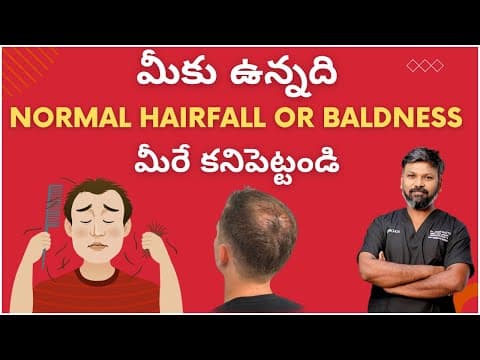
It is one of the most anxiety-inducing questions in hair care: is this just normal hair fall, or am I going bald? One viewer — who has a family history of baldness and started losing hair at a young age — said he had asked several doctors without getting a clear answer.
In this article based on his educational video, Dr. John Watts — dermatologist, trichologist and hair transplant surgeon in Hyderabad — explains that you can actually differentiate the two quite easily through close observation of your hair quality.
Clue 1: Where the hair is falling from
The first difference lies in location. In normal hair fall, hair sheds from all areas of the scalp. Baldness, by contrast, follows a pattern restricted to a few areas — typically the temples, front or crown.
“Your hair at the back of the scalp or near the ear will remain intact in case of baldness,” informed Dr. John Watts.
So if your shedding is even and all over, that points toward normal hair fall. If the loss concentrates at the temples, hairline or crown while the back and sides stay full, that is the signature of pattern baldness.
Clue 2: How the hair itself changes
The major difference, however, is in the hair strands themselves. In baldness, the length, thickness and colour of the balding hair change — turning greyish. “While hair fall due to normal reasons happens from all over, the hair loss due to baldness is restricted to few spots. It also results in what is known as miniaturization,” explained Dr. Watts.
In miniaturization, the hair at certain spots grows shorter and shorter with every growth cycle, gradually becoming invisible to the naked eye. Normal hair fall does not change the quality of the hair that remains; baldness slowly shrinks it.
Dr. Watts adds a curious observation seen in several people with baldness: their chest hair starts growing long while the scalp hair in the affected spots grows shorter.
What to do if you are still unsure
Self-observation is a good start, but it has limits — especially if you have a family history of baldness and early hair loss.
“If one is in further doubt, it is better to consult one's dermatologist for a clear-cut evaluation. If it's found linked to genetic baldness, then one can start medical treatment immediately or opt for a hair transplant procedure,” explained Dr. John Watts.
The earlier genetic baldness is confirmed, the earlier treatment can begin — and early treatment is what protects the hair you still have.
The bottom line
Normal hair fall happens evenly across the scalp and leaves hair quality unchanged. Baldness concentrates at the temples, front or crown, spares the back and sides, and miniaturizes the hair — shorter, thinner, lighter with every cycle. Check the pattern and check the strands; and if family history or doubt lingers, get a dermatologist's evaluation so treatment can start without delay.
This article is for educational purposes only and is not a substitute for professional medical advice. Consult a qualified dermatologist for diagnosis and treatment.
Instant Appointment Slot Booking
Frequently asked questions
How can I tell normal hair fall from baldness?
Normal hair fall occurs from all areas of the scalp, while baldness is restricted to a pattern — typically the temples, front or crown — with hair at the back of the scalp and near the ears remaining intact.
What is hair miniaturization?
In baldness, hair at affected spots grows shorter, thinner and greyish with each growth cycle, gradually becoming invisible to the naked eye. This change in hair quality is a key sign of baldness rather than normal shedding.
I have a family history of baldness and early hair fall. What should I do?
Dr. John Watts advises consulting a dermatologist for a clear-cut evaluation. If the loss is linked to genetic baldness, medical treatment can start immediately, or a hair transplant can be considered.
Does baldness affect body hair too?
Dr. Watts notes that in several people with baldness, chest hair starts growing long even as scalp hair in affected spots grows shorter.