

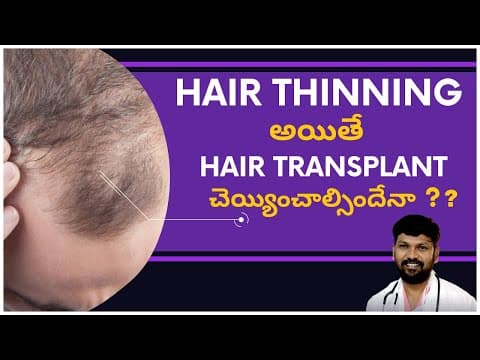
A common belief among hair transplant patients and the general public alike is that hair thinning inevitably leads to baldness — making a hair transplant unavoidable.
Is that true? Or is medical treatment sufficient for hair thinning? In this article based on his educational video, Dr. John Watts — a noted dermatologist, trichologist and hair transplant surgeon in Hyderabad with over 1900+ procedures performed — demystifies the topic.
Don't panic — find the cause
There is no need to panic in case of hair thinning, says Dr. John Watts. “Yes, this is a hair loss condition but it may not lead to baldness.”
Instead of panicking, try to find what is causing it. Some reasons for hair thinning include high stress levels, poor diet and nutritional deficiency. Even Telogen Effluvium can cause hair thinning.
“The best recourse is to take a close look at your life and introspect where you are going wrong, and then consult your dermatologist to find out the cause and immediately start medical treatment for its control,” advises Dr. Watts.
Tests your dermatologist may recommend
In the early signs of hair thinning, you do not immediately need a hair transplant. Your dermatologist may instead recommend tests to check HB (haemoglobin) levels, Vitamin B and Vitamin D levels, or thyroid hormone levels.
“Hair thinning is usually a treatable condition. Once the right diagnosis is made, one may recover the lost hair due to hair thinning in 6-8 months,” informs Dr. Watts.
One caveat: even in a normal hair thinning case, a receding hairline cannot be restored with plain medical treatment.
When to suspect hereditary hair loss
If your test reports come back normal but the thinning continues as usual, it is time to suspect hereditary hair loss. You can also suspect heredity if thinning resumes after you stop medical treatment.
“If hair thinning is due to a heredity issue, it may manifest into baldness. One can suspect signs of baldness when one notices a receding hairline at the sides or baldness at the crown. In such a condition, one needs to consult his/her dermatologist for an opinion,” says Dr. John.
Remember: without a hair transplant, a receding hairline or baldness at the crown cannot be restored.
The bottom line
Hair thinning does not mean baldness. “In 70% of hair thinning cases, medical treatment is sufficient. But if medical treatment does not work, the only option left is hair transplant,” sums up Dr. Watts. Get the cause diagnosed early — that is what decides whether medicine alone will be enough.
This article is for educational purposes only and is not a substitute for professional medical advice. Consult a qualified dermatologist for diagnosis and treatment.
Instant Appointment Slot Booking
Frequently asked questions
Does hair thinning always lead to baldness?
No. Hair thinning is a hair loss condition but it may not lead to baldness. In 70% of cases, medical treatment is sufficient once the cause is diagnosed.
What causes hair thinning?
Common causes include high stress, poor diet, nutritional deficiency and Telogen Effluvium. Tests for haemoglobin, Vitamin B, Vitamin D and thyroid levels help identify the cause.
How long does recovery from hair thinning take?
With the right diagnosis and medical treatment, lost hair from thinning may recover in 6-8 months.
When should I suspect hereditary hair loss?
If test reports are normal but thinning continues, or if thinning resumes after stopping treatment, heredity may be the cause — especially with a receding hairline at the sides or baldness at the crown.