

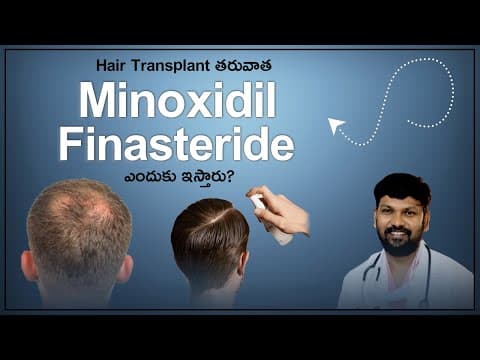
Why does a hair transplant surgeon often prescribe Minoxidil and Finasteride immediately after a hair transplant? Will the transplanted hair fail if these medications are avoided?
These are questions Dr. John Watts — noted dermatologist, trichologist and one of the leading hair transplant surgeons in Hyderabad, with over 1900+ successful hair and beard transplant surgeries — encounters frequently from his patients. In this article based on his educational video, he explains the real reason behind the prescription.
The transplanted hair doesn't need these drugs
“The transplanted hair will not fail or face problems if Minoxidil and Finasteride are not taken — but the same is not true in case of non-transplanted hair,” explains Dr. John Watts.
He adds: “We need to understand that Minoxidil and Finasteride medications have nothing to do with transplanted hair, but they are still prescribed as they are needed to help ensure the growth of existing hair (non-transplanted).”
What is native hair?
Native hair is the existing, non-transplanted hair — the hair untouched during the procedure. For instance, a transplant may use donor hair from the back of the scalp, placed at the front. In that case, the top hair remains untouched; this is the native hair, which may need Minoxidil and Finasteride to keep growing.
Why protecting native hair matters
“In many hair transplant cases, there runs a strong genetic disposition of baldness in the family of the patient. Sooner or later — say 1, 2 or 3 years — they are likely to face baldness issues even after a transplant. Hence, the existing non-transplanted native hair is protected with the use of Minoxidil and Finasteride,” explains Dr. Watts.
If native hair is lost to baldness without any protective steps, patients may need a second round of transplant surgery. “The problem becomes acute if there is no donor hair left. In such a scenario, the only alternative left is to go for a hair patch or bio fibre — artificial hair,” he adds.
How the two drugs work
Minoxidil is known to help prolong the anagen (growth) phase of the hair. It also helps ensure blood circulation to the scalp and makes existing hair stronger. Finasteride acts as a DHT blocker and prevents hair loss.
What about side effects?
Dr. Watts acknowledges that Finasteride may act differently for different people, with side effects observed in about 2% of users. “If it shows side effects, stop using it. But choices get limited if one completely avoids it without even trying out of fear,” he says — while reiterating that these two drugs should never be self-medicated or taken without expert supervision or prescription.
The bottom line
Minoxidil and Finasteride after a transplant are not for your new grafts — they are insurance for your remaining native hair against progressing genetic baldness. Skipping them risks further loss, a second surgery, or running out of donor hair altogether. Use them only under expert supervision.
This article is for educational purposes only and is not a substitute for professional medical advice. Consult a qualified dermatologist for diagnosis and treatment.
Instant Appointment Slot Booking
Frequently asked questions
Will transplanted hair fail without Minoxidil and Finasteride?
No. The transplanted hair will not fail without these medications. They are prescribed to protect the existing non-transplanted (native) hair from ongoing genetic baldness.
What is native hair?
Native hair is the existing hair untouched during the transplant — for example, the top hair when grafts from the back of the scalp are placed at the front. It may still be vulnerable to genetic baldness.
How do Minoxidil and Finasteride work?
Minoxidil prolongs the anagen growth phase, supports scalp blood circulation and strengthens hair. Finasteride acts as a DHT blocker to prevent hair loss.
What if Finasteride causes side effects?
Side effects are seen in about 2% of users. If they appear, stop the drug — but avoiding it entirely out of fear without trying limits your options. Always use it under expert supervision.