

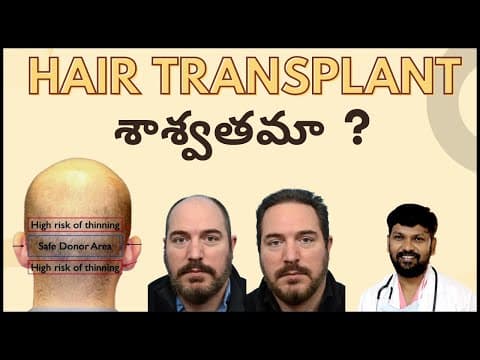
A common misconception about hair transplants is that the results may not stay permanent. Will the transplanted hair survive long term? Does it look good initially and then fall out? How long does it really last?
In this article based on his educational video, Dr. John Watts — a noted dermatologist, trichologist and hair transplant surgeon in Hyderabad who has successfully performed over 1,900 hair transplant procedures — demystifies these misconceptions.
A century-old, advanced science
Dr. Watts reminds viewers that the science of hair transplantation is about 100 years old. "We are now in an advanced phase of hair transplant science," he informed.
The key point: when permanently growing, non-DHT influenced donor hair grafts are extracted and implanted, the results are real, natural and permanent.
Don't panic when transplanted hair sheds early
"It is also true that in the first 15-20 days of hair transplant, the transplanted hair would fall. In their place, new hair would start growing after 2-3 months," informed Dr. John Watts. This early shedding is expected and not a sign of failure.
It also helps to understand the hair life cycle. "The human hair normally has an average life cycle of 2-8 years. After that, new hair again starts growing in their place and it is repeated," he said.
DHT vs non-DHT hair: the key difference
The third concept Dr. Watts highlighted is the difference between DHT-influenced and non-DHT influenced hair on the scalp. DHT-influenced hair eventually paves the way for baldness.
"The hair growing on the front of the scalp, top and crown are generally DHT influenced and are not considered safe donor hair for hair transplant," informed Dr. Watts. This explains why a 30-year-old patient may show the same receding hairline and balding pattern as his 50-year-old father — heredity at work.
"If someone who had undergone a hair transplant with donor hair extracted from an unsafe donor area or DHT influenced zone, the hair transplant results would be poor or minimal," he explained. The solution is choosing the right hair expert, who will extract grafts only from a safe, non-DHT influenced donor region.
Your role after the surgery
There is a catch: even with grafts from a safe donor area, results can be affected if the patient ignores post-operative guidance. "It is essential that the hair transplant patient sticks to a healthy and nutritionally rich diet recommended by his doctor after a transplant and follows other advisories without fail," advised Dr. Watts.
The bottom line
Hair transplant results are permanent — provided the grafts come from a safe, non-DHT influenced donor zone and the patient follows post-operative care diligently. Early shedding in the first 15-20 days is normal, with new growth arriving in 2-3 months. The surgeon you choose matters as much as the surgery itself.
This article is for educational purposes only and is not a substitute for professional medical advice. Consult a qualified dermatologist for diagnosis and treatment.
Instant Appointment Slot Booking
Frequently asked questions
Are hair transplant results permanent?
Yes — when permanently growing, non-DHT influenced donor hair grafts are extracted and implanted, the results are real, natural and permanent, according to Dr. John Watts.
Why does transplanted hair fall out in the first few weeks?
In the first 15-20 days after a transplant, the transplanted hair sheds. This is normal — new hair starts growing in its place after 2-3 months.
What is the difference between DHT and non-DHT influenced hair?
DHT-influenced hair (typically on the front, top and crown) eventually leads to baldness and is unsafe as donor hair. Non-DHT influenced hair grows permanently and is used for grafts.
Can a hair transplant fail even with safe donor grafts?
Results can be affected if the patient does not follow the doctor's post-operative advice, including a healthy, nutritionally rich diet.