

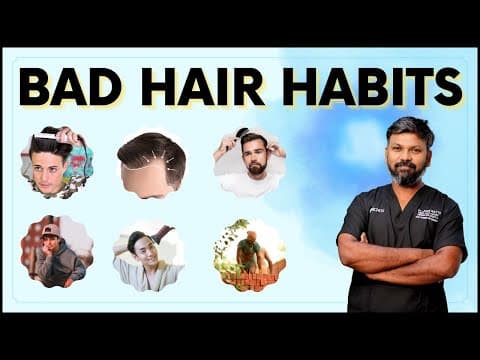
Our scalp hair is probably the most neglected part of the body. Most people take their hair for granted and wait until there is visible damage before paying attention — and by then, both hair health and the scalp may have suffered.
In this article based on his educational video, Dr. John Watts — dermatologist, trichologist and hair transplant surgeon in Hyderabad with over 2,000 hair transplant procedures performed — highlights the bad hair habits to avoid for healthy, glowing and growing hair.
Shampoo your scalp, not your hair
The purpose of shampooing is to clean the scalp and maintain its hygiene. However, many people target the hair instead. If shampoo is used on the hair rather than to clean the scalp, the hair's essential oil is stripped away in the process, says Dr. Watts.
A related mistake: using only shampoo without a conditioner. Since shampooing often strips essential oil, hair can become dry and develop split ends. Using a conditioner after shampoo avoids this.
Dry and comb your hair gently
Forcefully rubbing wet hair with a towel applies shearing force that can break weak hair. Blow-drying at hot temperatures is also harmful. "Instead, one can dab a towel to dry wet hair or use a dryer with minimum heat and maintain at least 15-20 cm distance from the scalp," advised Dr. John Watts.
And never comb wet hair directly — especially with a fine-toothed lice comb. "Wet hair needs to dry first. Then one can use a wide tooth comb for tangle-free results that do not cause damage to the hair," he said.
Go easy on styling tools and gels
Hair straightening irons, curling irons and hot irons all cause cumulative damage. "The peptide bonds of the hair can break or the hair can become brittle with such artificial procedures. Using hair straightening iron, or hair curling iron or hot iron can be fine once a year but should not be used frequently," warned Dr. Watts.
Chemical-laced hair gels — wet gel, hard gel or wax — can leave inflammation on the scalp. "This may lead to hair loss in the long run," he warned. Regular use of chemical hair dyes, often bought under the influence of TV ads, can also cause long-term damage.
Avoid tight braiding, extensions and extreme temperatures
Tightly braiding hair or pulling it into a tight ponytail — by men or women — can lead to traction alopecia, a type of hair loss. "People of the Sikh community often tie their hair tight. You should avoid tight braiding of hair as it may cause permanent hair loss," said Dr. John.
Regularly wearing hair extensions or opting for hair weaving without expert supervision can also cause traction alopecia. Finally, exposing your hair to extreme heat or cold can damage it too.
The bottom line
Healthy hair is mostly about avoiding self-inflicted damage: shampoo the scalp, condition the hair, dry it gently, skip the hot tools and tight hairstyles, and be wary of chemical gels and dyes. If damage has already set in, a professional assessment can tell you whether it is reversible.
This article is for educational purposes only and is not a substitute for professional medical advice. Consult a qualified dermatologist for diagnosis and treatment.
Instant Appointment Slot Booking
Frequently asked questions
Is it bad to comb wet hair?
Yes. Combing wet hair, especially with a fine lice comb, can damage it. Let hair dry first, then use a wide-tooth comb for tangle-free results.
Can tight braiding cause permanent hair loss?
Yes. Tight braiding or ponytails can cause traction alopecia, which may lead to permanent hair loss.
How should I dry my hair after a head bath?
Dab gently with a towel instead of rubbing, or use a dryer on minimum heat held at least 15-20 cm from the scalp.
Are hair straightening and curling irons safe?
Frequent use can break the peptide bonds of hair and make it brittle. Dr. Watts says using them once a year may be fine, but not frequently.