
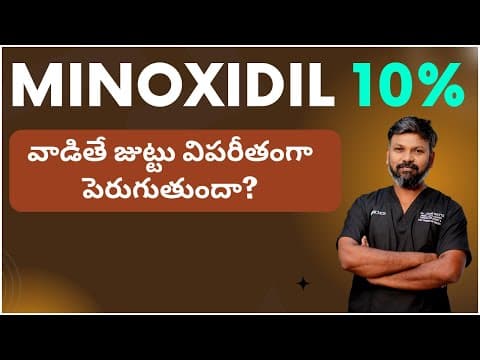
A viewer, Ramesh CH, asked Dr. John Watts: "Will it be any different if I use 5% or 10% Minoxidil for hair growth? Which one will be better?"
In this article based on his Q&A video, Dr. John Watts — dermatologist, trichologist and hair transplant surgeon in Hyderabad — answers this question along with another viewer query on DHT and free testosterone.
Start low, not high
Dr. Watts tells first-time users not to jump to a higher dosage. "Initially, I would suggest 2% Minoxidil for the first-time hair loss patient using the medication. Based on the results, then a decision can be taken whether the dosage should be upgraded," he advised.
Never self-medicate with Minoxidil
He strongly warned against taking Minoxidil without a dermatologist's advice. "If you are taking this medication without a prescription, then you should not even think of using it on your own as self-medication could backfire. Many people have the habit of buying medicines Over the Counter (OTC)," warned Dr. John Watts.
The correct procedure is to have the cause of hair fall properly assessed by a qualified dermatologist before fixing a prescription. "Sometimes, one may not even need to buy Minoxidil as the cause of hair loss could be something else like a deficiency in vitamins or nutrition or inadequate blood," said Dr. Watts.
DHT vs free testosterone: what's the difference?
Another viewer, Trishank Kumar, asked whether DHT and free testosterone are the same, and whether a DHT blocker affects testosterone levels.
Dr. Watts explained that testosterone is released in males at puberty, while in girls the oestrogen hormone gets activated. "These hormones result in the development of secondary sexual characters in boys and girls such as the growth of moustache and pubic hair. It also signals the maturing of sexual organs," he explained.
Trouble begins when testosterone gets converted into Dihydrotestosterone (DHT). "Under the influence of DHT, the baldness process can set in and lead to male pattern baldness and receding of the hairline. The front, top and crown areas of the scalp can lose hair under its impact," explained Dr. Watts.
Do DHT blockers affect free testosterone?
On the second part of the question, Dr. Watts clarified that a DHT blocker — used to control baldness caused by the DHT hormone — will not have any impact on free testosterone. "Hence, you need not worry," he informed.
The bottom line
Higher-strength Minoxidil is not automatically better: beginners should start at 2% and upgrade only based on results and a dermatologist's advice. More importantly, get the cause of your hair loss diagnosed first — it may not need Minoxidil at all. And if you're prescribed a DHT blocker, it won't touch your free testosterone levels.
This article is for educational purposes only and is not a substitute for professional medical advice. Consult a qualified dermatologist for diagnosis and treatment.
Instant Appointment Slot Booking
Frequently asked questions
Should I use 5% or 10% Minoxidil?
Dr. John Watts suggests first-time users start with 2% Minoxidil, then decide on upgrading the dosage based on results — not jump straight to higher strengths.
Can I buy and use Minoxidil on my own?
No. Self-medication can backfire. The cause of hair loss should first be assessed by a dermatologist — sometimes the cause is a vitamin or nutritional deficiency and Minoxidil isn't needed at all.
What is DHT and how is it different from testosterone?
DHT (Dihydrotestosterone) is formed when testosterone gets converted. Under DHT's influence, male pattern baldness can set in, affecting the front, top and crown of the scalp.
Do DHT blockers reduce free testosterone?
No. Dr. Watts clarifies that DHT blockers used to control baldness have no impact on free testosterone levels.