

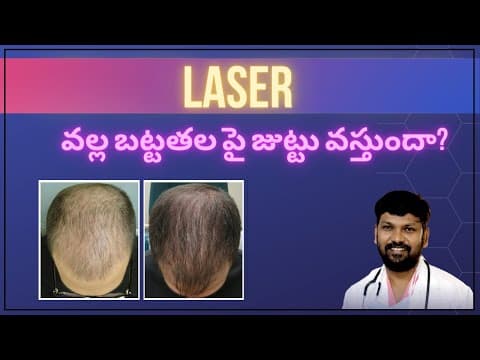
Laser caps, laser combs, and devices marketed as low-level laser therapy (LLLT) for hair loss have become increasingly popular. But can they actually reverse baldness and give you thick, styleable hair? In this article based on his educational video, Dr. John Watts -- dermatologist, trichologist and hair transplant surgeon in Hyderabad -- cuts through the marketing claims with an honest scientific assessment.
The origins of LLLT for hair
The concept of low-level laser therapy was first explored more than 50 years ago by Hungarian researcher Endre Mester during cancer experiments. Mester found that when low-level LED light was emitted on bald mice for a sustained period, hair regrowth occurred. This finding led to commercial products like laser caps and combs, claiming they can reverse human baldness.
What the science actually shows
Research confirms that LED light emitted onto a bald spot can stimulate proliferation of follicular hair stem cells -- which in theory represents a reversal of the baldness process at a cellular level. But proliferation of stem cells and visible, dense hair growth are two very different things.
"No! The results are not very effective. At the most, one can get some results but tiny vellus hair cannot convert to dense terminal hair that you can style," says Dr. John Watts.
Who might benefit -- and who won't
LLLT may offer some benefit to people in the early stages of baldness. For those with advanced baldness, the therapy is unlikely to deliver meaningful results. Another significant drawback is time.
"Probably, one needs up to 26 weeks to get some results. But why wait this long when there are other effective alternatives available?" asks Dr. John Watts.
Better alternatives for early-stage baldness
For patients in the early stage of baldness, Dr. Watts recommends consulting a trichologist about Minoxidil or Finasteride -- both medically approved drugs with stronger evidence for hair retention and regrowth.
Bottom line
LLLT is not a scam, but its results are modest at best -- fine, non-styleable vellus hair, not the dense growth advertisers imply. For early baldness, medically approved drugs offer faster, more reliable results. For advanced baldness, a hair transplant is the standard of care.
This article is for educational purposes only and is not a substitute for professional medical advice. Consult a qualified dermatologist for diagnosis and treatment.
Instant Appointment Slot Booking
Frequently asked questions
Can LLLT reverse baldness completely?
No. According to Dr. John Watts, LLLT can at most produce fine vellus hair -- it cannot convert these into the dense terminal hair you can style.
How long does LLLT take to show results?
Approximately 26 weeks. Dr. Watts points out that medically approved alternatives like Minoxidil and Finasteride are more effective for early-stage baldness.
Who is LLLT suitable for?
Those in the early stages of baldness may see some modest benefit. For moderate or advanced baldness, Dr. Watts recommends proven medical treatments or a hair transplant instead.