

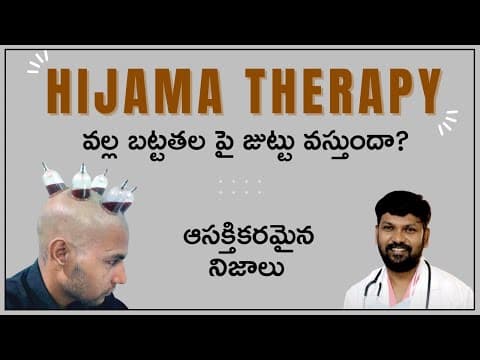
Many people are confused about whether the ancient practice of Hijama therapy can boost hair growth or prevent baldness. With clinics now advertising it as a hair loss treatment, it is worth asking what the evidence actually says.
In this article based on his educational video, Dr. John Watts — dermatologist, trichologist and hair transplant surgeon in Hyderabad — demystifies Hijama therapy for lay readers, drawing on his own interactions with patients who have tried it.
What is Hijama therapy?
Hijama, alternatively known as cupping therapy, is an ancient Greek treatment technique. Dr. Watts says he has seen its traces firsthand: “I used to see some patients come to me with reddish patches on their neck. When I enquired, I was told that it is a leftover mark from Hijama therapy.”
In its earlier form, herbs were burnt in a cup, which was then upturned and placed on the body — the resulting vacuum formed the basis of the therapy. In the modern era, the technique has become more advanced: air is suctioned out of the inverted cup, and special needles are used to let out so-called bad blood from the body.
Practitioners use it for conditions like joint pain, back pain, body pain, acne, facial paralysis and cervical spondylosis. In a session, the inverted cups are placed on the body for 2-4 minutes. A known side effect is reddish skin patches left behind on the skin.
The theory: removing bad blood
“The core principle of Hijama therapy is to remove bad blood, which is said to be responsible for one's health condition,” explains Dr. Watts.
But when he went hunting for research articles on this treatment, the search came up empty. “I did not find any scientific articles on the concept of bad blood,” he said — adding that he found no studies in reputed international journals highlighting the therapy's efficacy.
Can cupping prevent baldness?
This is where the claim runs into a basic scientific problem. Baldness in most men is driven by Dihydrotestosterone (DHT). Dr. Watts questions how removing bad blood could possibly separate out or neutralize DHT's influence on hair follicles — the bad blood principle simply does not map onto how genetic baldness works.
His clinical experience points the same way: “In my interactions with Hijama patients who had used this treatment technique for baldness prevention and hair growth, they told me that there were no visible progress,” he said.
The bottom line
Hijama or cupping therapy is an ancient practice that some people use for pain and other conditions, but there is no scientific evidence in reputed journals supporting it as a hair growth or baldness treatment — and the bad blood theory has no published scientific basis. Patients who tried it for hair loss reported no visible progress to Dr. Watts. If you are losing hair, especially to genetic baldness, evidence-based diagnosis and treatment will serve you far better.
This article is for educational purposes only and is not a substitute for professional medical advice. Consult a qualified dermatologist for diagnosis and treatment.
Instant Appointment Slot Booking
Frequently asked questions
What is Hijama (cupping) therapy?
An ancient Greek treatment technique. Originally herbs were burnt in a cup placed upturned on the body to create a vacuum; the modern version suctions air from the cup and uses special needles to let out so-called bad blood. Cups are placed for 2-4 minutes per session.
Does Hijama therapy help hair growth or prevent baldness?
Dr. John Watts found no scientific articles in reputed international journals supporting its efficacy, and patients he spoke with who tried it for baldness reported no visible progress.
What is the bad blood theory behind cupping?
The core principle is that removing bad blood cures health conditions. Dr. Watts found no scientific literature supporting the concept, and questions how it could address DHT — the hormone driving genetic baldness.
Does Hijama therapy have side effects?
Yes — it is known to leave reddish skin patches where the cups are placed.