

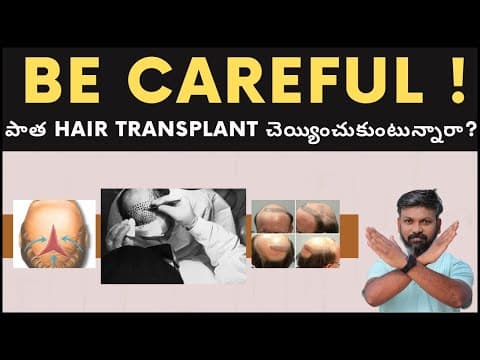
Young people facing baldness often hesitate to socialize, feel embarrassed in family photographs, or worry about their marriage prospects. Is a hair transplant really a viable, effective solution, or is it overhyped? Dr. John Watts, a dermatologist, trichologist and hair transplant surgeon in Hyderabad who has performed over 1,900 hair transplant procedures, addresses this question by explaining what the procedure actually does and how far the science has come.
A Boon, Not Hype
Dr. Watts is clear in his assessment: a hair transplant is a boon and a source of hope for people dealing with baldness, because it provides natural hair growth with no side effects. The underlying science isn't new either -- hair transplant techniques were first developed more than 100 years ago.
Why Donor Hair Works
"If one closely observes bald people, one may notice that their sides and back of the scalp are usually unaffected by baldness," Dr. Watts says. These are the permanently growing, non-DHT-influenced safe donor hair follicles. When these grafts are extracted and implanted in balding regions, they provide real, natural, and permanent hair that can be comfortably cut, styled or shaved.
A Century of Technique Evolution
The oldest and crudest hair transplant technique was the "Flap method," which left deep cuts and visible suture marks. It was followed by the "Mercedes incision technique," which used incisions to insert "hair plugs" into bald spots. "The two above techniques enabled successful and naturally growing hair on the bald spots but they looked unnatural and were soon replaced by more advanced techniques," Dr. Watts recalls.
The FUT Breakthrough -- and Its Limitation
Next came the "Strip method," also known as FUT (Follicular Unit Transplantation), where hair grafts are extracted as a strip of scalp, sliced into individual follicular units, and then transplanted. "The FUT technique revolutionised hair transplant science but its only disadvantage was that it left a scar mark. To overcome this problem, a newer advanced technique called FUE came," Dr. Watts explains.
FUE: No Visible Scarring
FUE (Follicular Unit Extraction) uses small punch sizes to extract individual hair grafts, which are then implanted through microscopic slits while maintaining the exact angle and direction of natural hair growth, with no large scar left behind. "This provided natural-looking hair that no one could distinguish or even get a hint that one had undergone a hair transplant," Dr. Watts says.
Newer Advances and Body Hair Grafts
FUE has since advanced further with techniques like Bio FUE and DHI (Direct Hair Implantation), and now even allows transplantation of body hair from the beard, chest, abdomen, upper back and pubic regions. "If one has less donor hair, FUE technique can ensure hair graft extraction from one's body," Dr. Watts notes.
Why This History Matters for Patients Today
Understanding this evolution helps explain why modern hair transplants look so different from what people may have seen or heard about in the past. The early flap and plug techniques left visible marks and an unnatural appearance, which is likely the source of much of the skepticism around hair transplants. FUT improved on this significantly but still left a linear scar. FUE, and its further advancements like Bio FUE and DHI, removed that drawback almost entirely, which is why Dr. Watts describes today's results as indistinguishable from natural hair.
For someone weighing whether a hair transplant is a boon or hype, Dr. Watts's answer is unambiguous: with over a century of refinement behind it, and techniques like FUE now offering natural results with minimal visible evidence of surgery, it is a real, workable solution -- not a gimmick.
This article is for educational purposes only and is not a substitute for professional medical advice. Consult a qualified dermatologist for diagnosis and treatment.
Instant Appointment Slot Booking
Frequently asked questions
Is hair transplant a real solution or just hype?
Dr. Watts says it's a genuine, permanent solution -- the science is over 100 years old and provides natural hair growth with no side effects.
Why does hair from the back and sides of the scalp work as donor hair?
This hair is naturally resistant to DHT, the hormone that causes pattern baldness, so it keeps growing permanently once transplanted elsewhere on the scalp.
What is the difference between FUT and FUE?
FUT (the "Strip method") extracts a strip of scalp for grafts but leaves a scar; FUE extracts individual grafts with small punches, leaving no visible scarring.
Can body hair be used for a hair transplant?
Yes. FUE technique allows extraction of grafts from the beard, chest, abdomen, upper back and pubic regions when scalp donor hair is limited.