
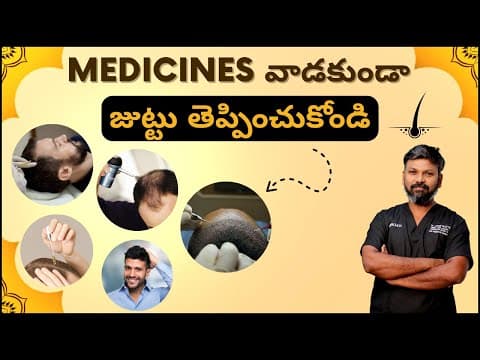
When oral hair medications produce side effects or fail to work, patients are often left wondering what to do next. In this article based on his educational video, Dr. John Watts — dermatologist, trichologist and hair transplant surgeon in Hyderabad with over 2,000 successful procedures — lays out a clear set of alternatives.
The case: allergic to oral hair medications
Srikanth Guggela had tried multiple hair medications across different hospitals but found that oral medications caused itchy rashes on his body. He asked Dr. Watts what other options were available.
Dr. Watts explained the situation simply: “If tablets or oral medications have led to side effects, it signifies that he is allergic to such hair medications. The solution is to stop using such oral medications immediately, as your body is sensitive to allergy from such medications.”
1. Topical minoxidil lotion
The first option is a topical minoxidil lotion applied to the scalp, which promotes hair growth by increasing blood supply and nutrition to the hair roots — without the systemic exposure that causes allergic reactions in some patients.
2. Topical minoxidil + finasteride combo lotion
A combined topical lotion containing both minoxidil and finasteride can increase blood supply to the hair roots and target DHT to prevent further baldness — both benefits without oral tablets.
3. PRP therapy
Platelet-Rich Plasma (PRP) therapy contains growth factors that promote the growth of new hair follicles, leading to thicker, healthier hair. It uses the patient's own blood, so systemic allergic reactions are not a concern.
4. Growth Factor Concentrate (GFC)
GFC is an advanced form of PRP therapy. “It uses growth factors derived from the patient’s blood to promote hair growth and reduce hair loss. The growth factors are extracted from the blood and injected directly into the scalp,” explained Dr. Watts.
5. Dermaroller (micro-needling)
The dermaroller creates controlled, tiny punctures in the scalp to stimulate hair growth on bald areas. “This is a good alternative but it must be carried out under medical supervision only,” Dr. Watts cautioned.
6. Hair fibre
Hair fibre is a camouflage solution that artificially increases the appearance of density on the scalp. Results are temporary but immediate.
7. Hair transplant
A hair transplant provides permanent hair growth results. “Transplanted hair can be cut and shaved like normal hair. They provide the best solution for baldness. The only condition for a successful hair transplant is the availability of adequate DHT-free donor hair at the back of one’s scalp,” Dr. Watts explained.
Dr. Watts concluded that Srikanth may choose any of the above-listed alternative solutions based on suitability and medical advice.
This article is for educational purposes only and is not a substitute for professional medical advice. Consult a qualified dermatologist for diagnosis and treatment.
Instant Appointment Slot Booking
Frequently asked questions
What should I do if oral hair medications cause side effects?
Stop the medication immediately. Dr. John Watts recommends switching to non-oral alternatives such as topical minoxidil, PRP therapy, GFC, or dermaroller under medical supervision.
What is the difference between PRP and GFC therapy?
GFC is an advanced form of PRP. Both use growth factors from the patient's own blood, but GFC delivers a higher concentration of growth factors directly to the scalp.
Is hair transplant an option when medications fail?
Yes. A hair transplant provides permanent results and transplanted hair behaves like normal hair. The prerequisite is sufficient DHT-free donor hair at the back of the scalp.