

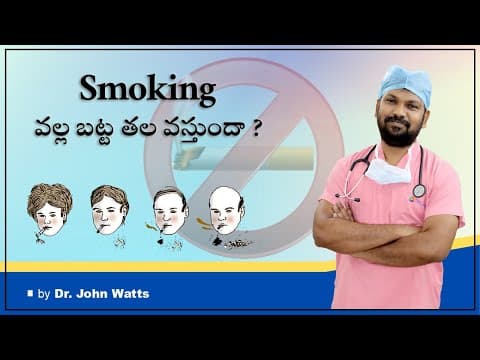
Does smoking cause hair loss? According to Dr John Watts, a leading hair transplant surgeon in Hyderabad with over 1,800 procedures to his name, the answer is a clear yes. "Smoking is linked to hairloss condition," he says, and the mechanism behind it is well documented in scientific research. Dr Watts breaks down the impact of smoking on hair loss step by step, for laypersons to understand.
The Bigger Picture: Smoking and Overall Health
Smoking is already well known to contribute to serious health problems, including morbidity, stroke, paralysis and various other pulmonary diseases. Dr Watts points out that even sustained passive smokers, who are regularly exposed to secondhand smoke, can come under its impact — including its effects on hair health.
What the Research Shows
Dr Watts refers to a scientific study comparing smokers with non-smokers, which found that smoking slows down hair growth and gradually induces baldness. Smoking is also linked to premature ageing and lustreless skin. But unlike dull, aged-looking skin — which can potentially be reversed using cosmetic procedures and antioxidants — no such technique currently exists that can naturally reverse hair loss caused by smoking.
Four Ways Smoking Damages Your Hair
Dr Watts breaks the mechanism down into four distinct pathways.
First, smoking induces a condition where the microvessels — arterioles, capillaries and venules — that carry blood become narrower and stiffer. Some of these smallest vessels form the microvasculature network that supplies blood to the dermal papilla, the structure at the centre of hair generation. "However, blood flow to the hair gets affected due to smoking. With the result that it leads to hair loss as nutrients and oxygen supply to the hair are hit," says Dr Watts.
Second, a sustained smoking habit over time is known to induce an inflammatory condition called follicular fibrosis, which results in hair fall and affects hair growth.
Third, smoking may gradually lead to hair shedding through what is known as protease and anti-protease inhibitor activity. Due to this activity, the DNA foundation responsible for hair growth is disrupted, slowing down growth and eventually contributing to baldness.
Fourth, excess oil production on the scalp, induced by the nicotine present in tobacco, is the final way smoking is linked to hair loss. "The nicotine in tobacco releases dopamine, which eventually triggers excess oil production on the scalp. This extra oil on the scalp hinders hair growth," explains Dr Watts.
The Bottom Line
Dr Watts urges smokers concerned about hair loss to consider quitting, and stresses that seeking professional help is a legitimate and useful step. "There is nothing wrong in taking the help of a psychologist too if you intend to quit smoking," he says.
This article is for educational purposes only and is not a substitute for professional medical advice. Consult a qualified dermatologist for diagnosis and treatment.
Instant Appointment Slot Booking
Frequently asked questions
Does smoking cause hair loss?
Yes. Research comparing smokers and non-smokers found that smoking slows hair growth and gradually leads to baldness.
How does smoking damage hair follicles?
It narrows blood vessels feeding the hair follicle, triggers inflammation (follicular fibrosis), disrupts the DNA involved in hair growth through protease activity, and increases scalp oil production via nicotine-triggered dopamine release.
Can hair loss caused by smoking be reversed?
Unlike lacklustre, aged skin, which can be improved with cosmetic treatments and antioxidants, hair loss caused by smoking cannot currently be naturally reversed.
Does passive smoking also affect hair?
Yes, sustained exposure to passive smoking can also impact hair health, not just active smoking.
What should smokers worried about hair loss do?
Consider quitting, with professional support if needed. Dr Watts notes there's nothing wrong in seeking help from a psychologist to quit smoking.